
The Salar People
A Unique Muslim Ethnic Minority Preserving Central Asian Heritage in China
China is a multiethnic nation composed of 56 officially recognized ethnic groups. Each group possesses its own unique history, culture, and way of life. The Chinese government places considerable emphasis on protecting the cultural identities of these ethnic communities while promoting their development. In this edition of Chinese Mirror, we take a closer look at the Salar people, one of China’s distinctive Muslim ethnic minorities.


History and Origins
The Salar people are one of China’s officially recognized ethnic minority groups. They are also known simply as the “Sala.” Various theories exist regarding their origins, but many historians believe that their ancestors migrated to China from the Samarkand region of Central Asia.
Another theory suggests that they descended from the Salur tribe of the Western Turkic Khaganate. According to Turkic legends, the Salur tribe traced its lineage to the descendants of Oghuz Khan.
Traditional accounts state that the ancestors of the Salar people journeyed eastward carrying a copy of the Quran, sacred soil, and water on white camels. After a long migration, they arrived in what is now Qinghai Province. Attracted by the region’s fertile grasslands, rivers, and forests, they chose to settle there permanently.
Over time, the Salar people developed close relations with neighboring Han, Hui, and Tibetan communities, and through cultural interaction and intermarriage, the modern Salar ethnic group emerged.
Population and Distribution
According to the 2010 national census, the Salar population exceeded 130,000. They are concentrated mainly in Qinghai and Gansu provinces of northwestern China.
The Salar language belongs to the Turkic language family, although many Salar people are also fluent in Mandarin Chinese.
Religion and Daily Life
The Salar people are predominantly Muslim. Mosques and Muslim cemeteries can be found in many Salar villages, reflecting the important role Islam plays in their daily lives and cultural traditions.
Agriculture remains the primary livelihood of the Salar community. They cultivate wheat, barley, potatoes, peanuts, melons, grapes, and various vegetables, which form the foundation of their local economy.
Traditional Housing and Architecture
Traditional Salar homes are constructed using mud bricks and timber. Their architectural style reflects influences from both Central Asia and the Tibetan Plateau.
Many houses feature beautifully carved doors and windows, while fruit trees are commonly grown around residential compounds. Although modern housing has become increasingly common, many traditional architectural elements continue to be preserved.
Food Culture
The Salar diet is closely connected to agricultural traditions and Islamic dietary customs.
Common foods include wheat-based dishes, boiled mutton, baked breads, and a variety of sweet pastries. Milk tea and barley tea are among their favorite beverages.
While beef, mutton, and poultry are widely consumed, foods that do not comply with Islamic dietary principles are generally avoided.
Clothing and Adornments
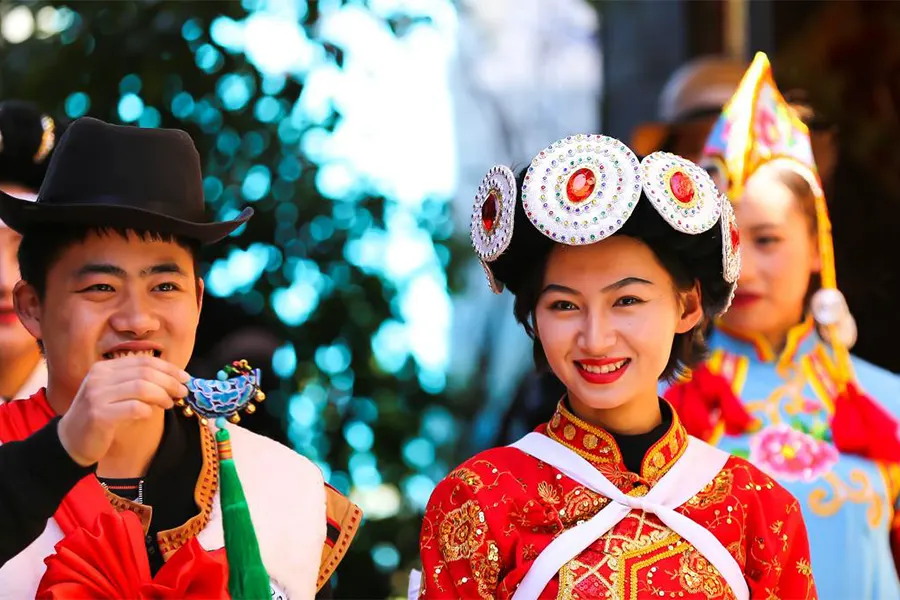
Salar clothing reflects strong influences from Islamic traditions and Central Asian cultural heritage.
Women traditionally wear headscarves, with colors often varying according to age. Younger women commonly wear green head coverings, while older women tend to wear black or white scarves.
Men usually wear white or black caps and, during winter, dress in warm garments made from sheepskin.
Festivals and Cultural Traditions
One of the most celebrated cultural events among the Salar people is the “Hua’er” folk song festival. Held during late spring and summer, the festival features singing competitions, traditional music, and cultural performances.
Participants are often given a specific theme and are expected to compose and perform songs spontaneously. The event showcases the creativity and artistic talents of the Salar community.
Music and Performing Arts
The Salar people possess a rich tradition of folk songs inspired by legends, historical narratives, and stories of love.
A distinctive musical tradition known as “Salar Qu” consists of long narrative songs that convey emotions and tell stories through extended lyrical compositions.
The community is also known for a traditional folk drama called “The Salar Camel.” This performance depicts the migration of the Salar ancestors and the hardships they endured during their journey to their new homeland.
Traditional Skin Rafts
One of the Salar people’s most remarkable traditional inventions is the skin raft. These boats are constructed using inflated animal skins attached to wooden frames.
Capable of carrying heavy loads, skin rafts played an important role in transportation and trade in earlier times.
Conclusion
The Salar people represent a small yet culturally significant ethnic minority in China. Their heritage reflects a unique blend of Central Asian traditions, Islamic faith, and Chinese cultural influences.
Although they have embraced modernization, the Salar people continue to preserve their language, customs, music, performing arts, and cultural identity. In doing so, they make a valuable contribution to the rich multicultural tapestry of contemporary China.
By Madushan Kularatne
Chinese Mirror – A Series on China’s Ethnic Minorities


